NEXUS AGENTIC AI

Multi-Agent Control Tower for automated server patching
ROLE

Product Designer

EXPERTISE

Product Strategy & UI

Core Problem

Core Problem

Core Problem

Enterprise server patching is a high-stakes, manual bottleneck that forces infrastructure teams to balance critical security updates against the risk of system downtime.

  • Fragmented Workflows: Engineers manually navigate disparate tools and compliance checks across thousands of nodes.

  • High Margin for Error: Manual execution drains resources and increases risk during critical update windows.

The Solution

The Solution

The Solution

A Multi-Agent Control Tower that shifts the paradigm from manual execution to autonomous orchestration.

  • Agentic Heavy Lifting: AI agents autonomously handle dependency mapping and staggered deployments.

  • Centralized Oversight: The interface provides high-level visibility, preserving crucial human-in-the-loop control for mission-critical systems.

Designing the Human Handoff

Designing the Human Handoff

Designing the Human Handoff

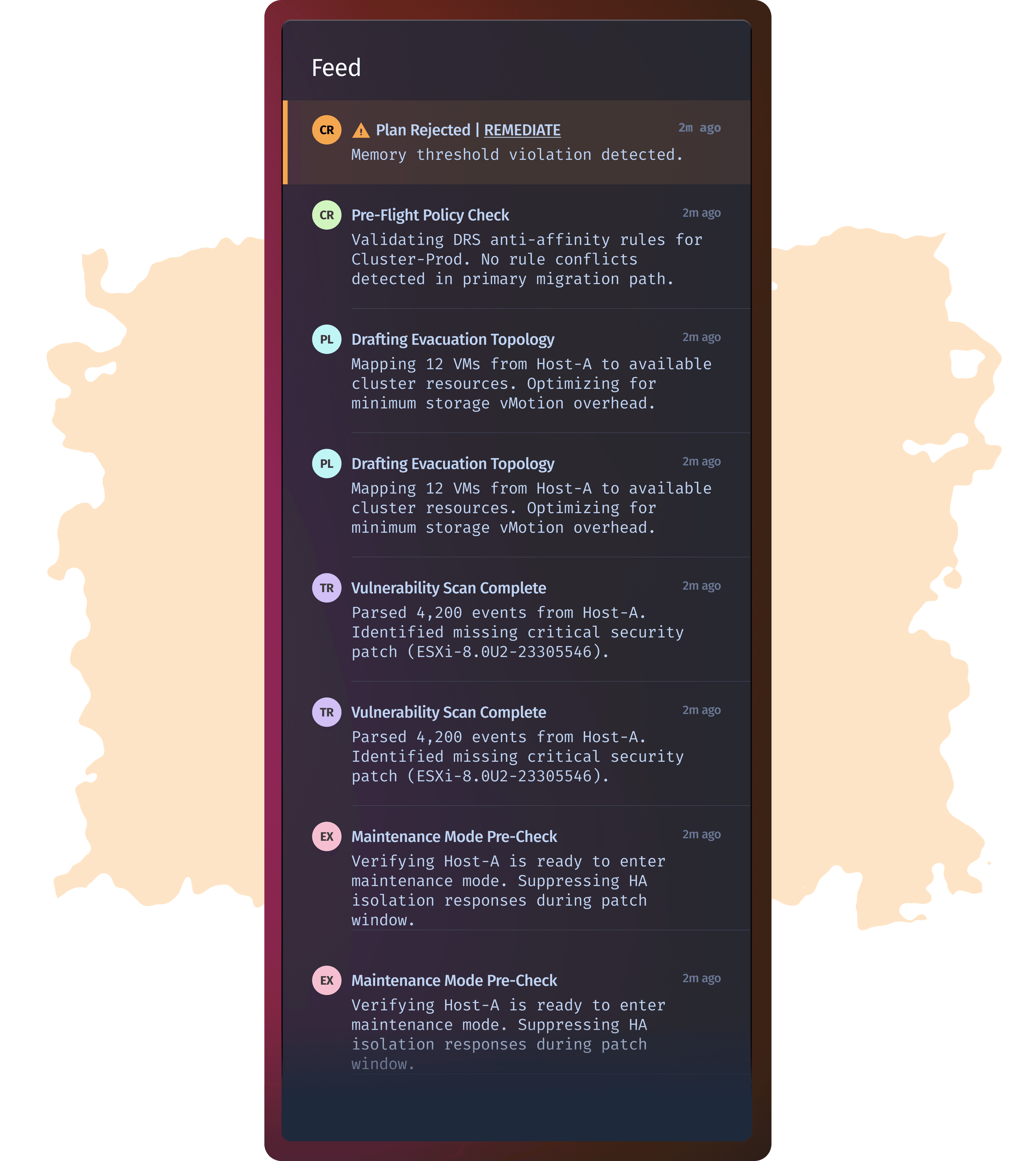
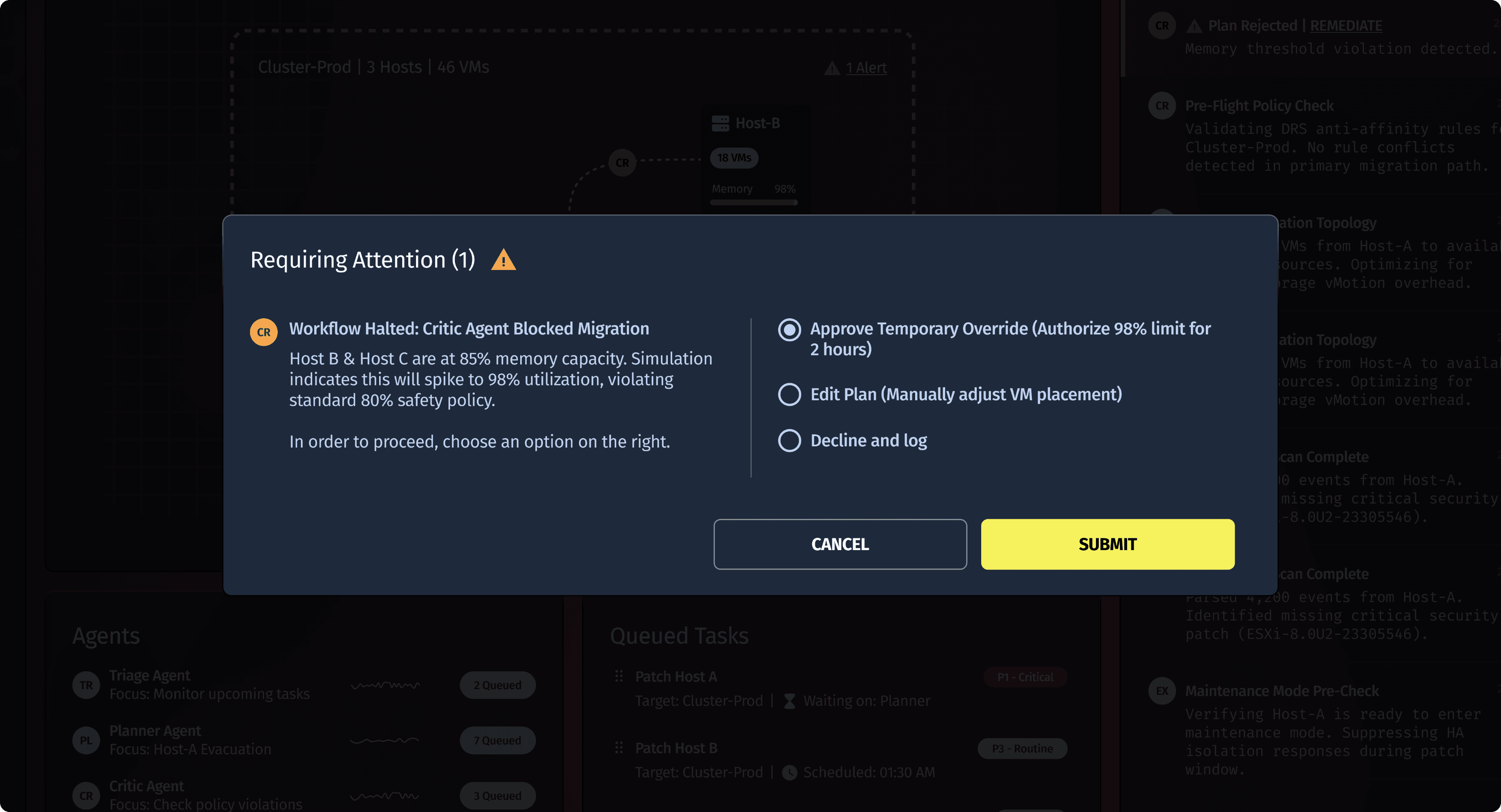
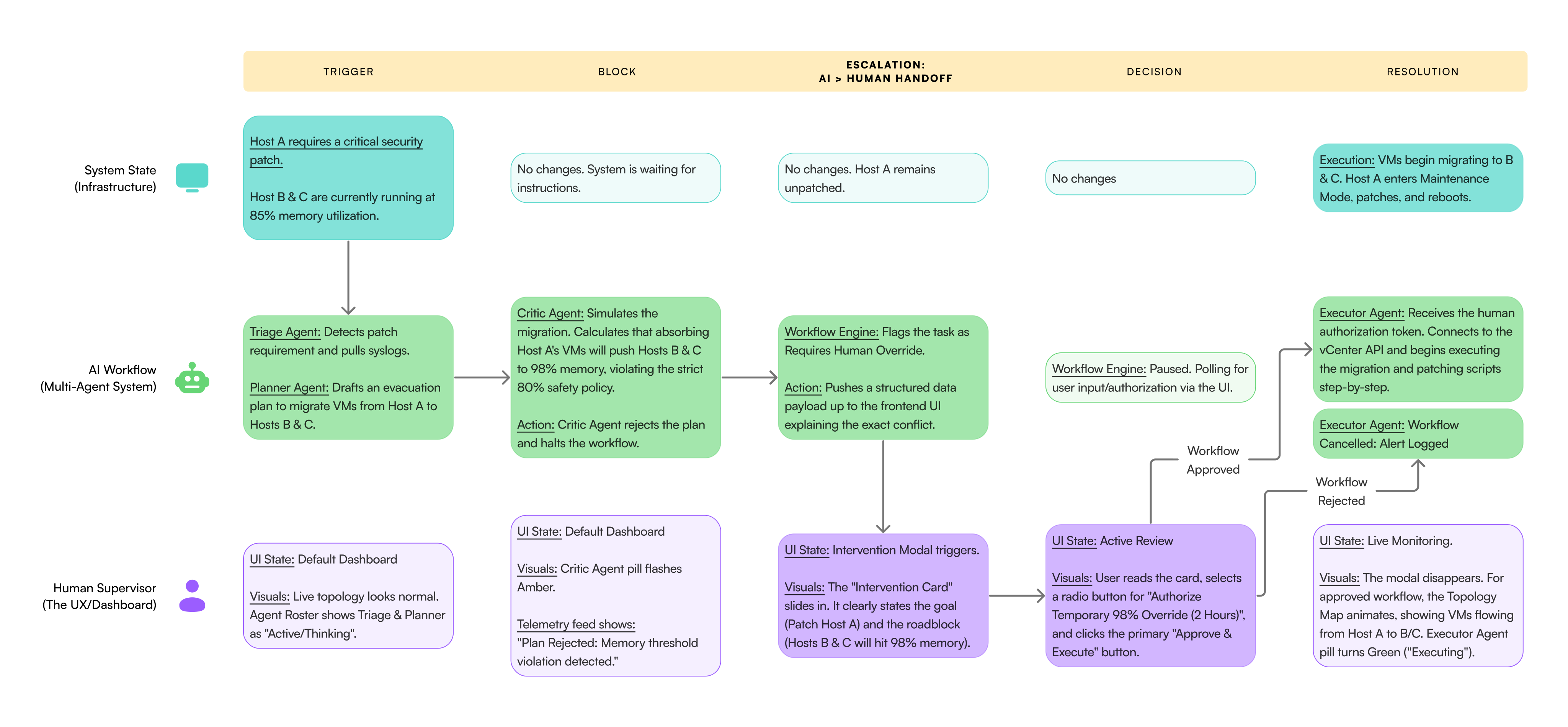
To ensure system safety, the AI workflow is structured to halt and escalate to a human supervisor whenever memory thresholds are threatened.
Defining the structure

Defining the structure

Defining the structure

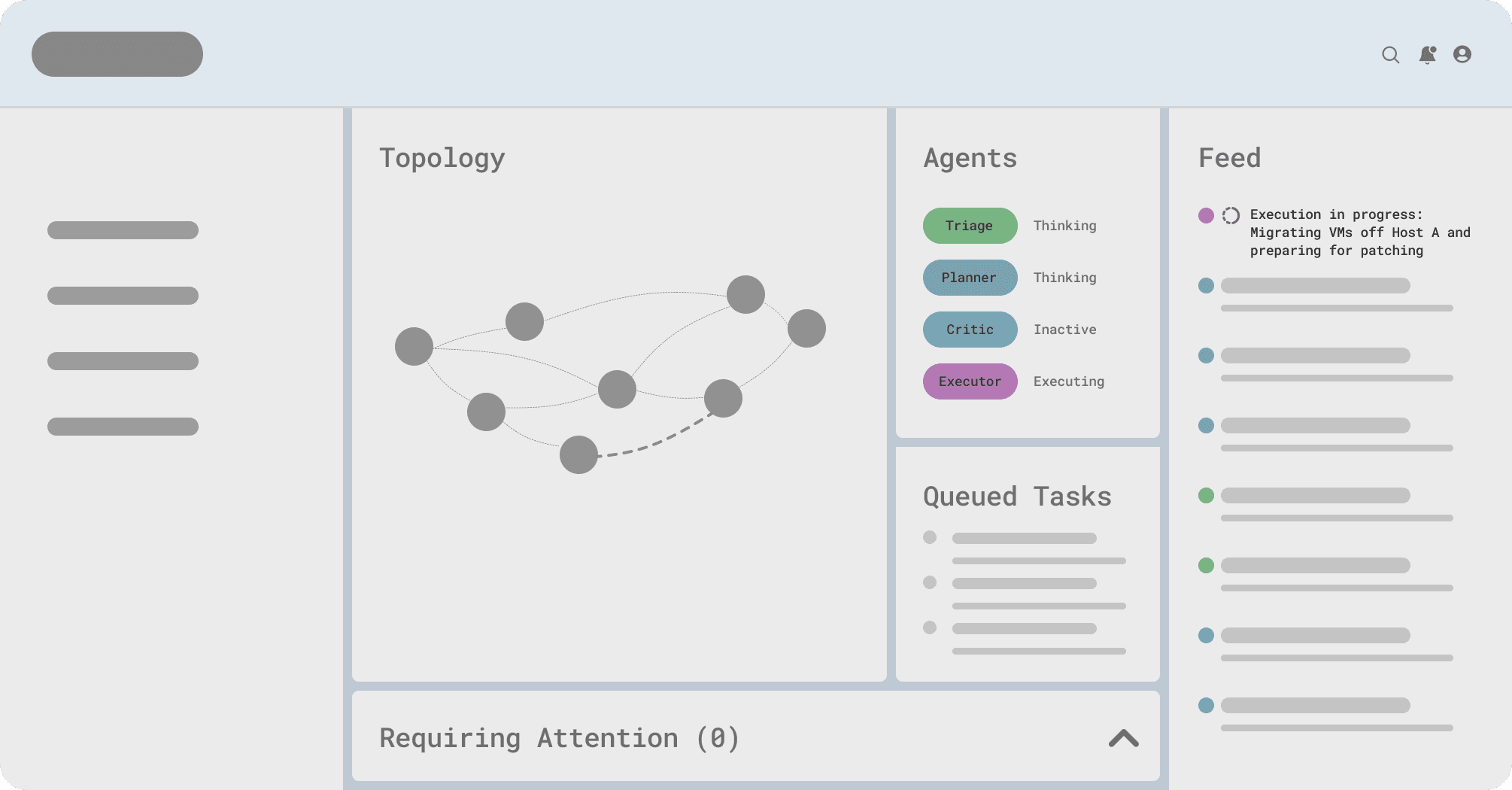
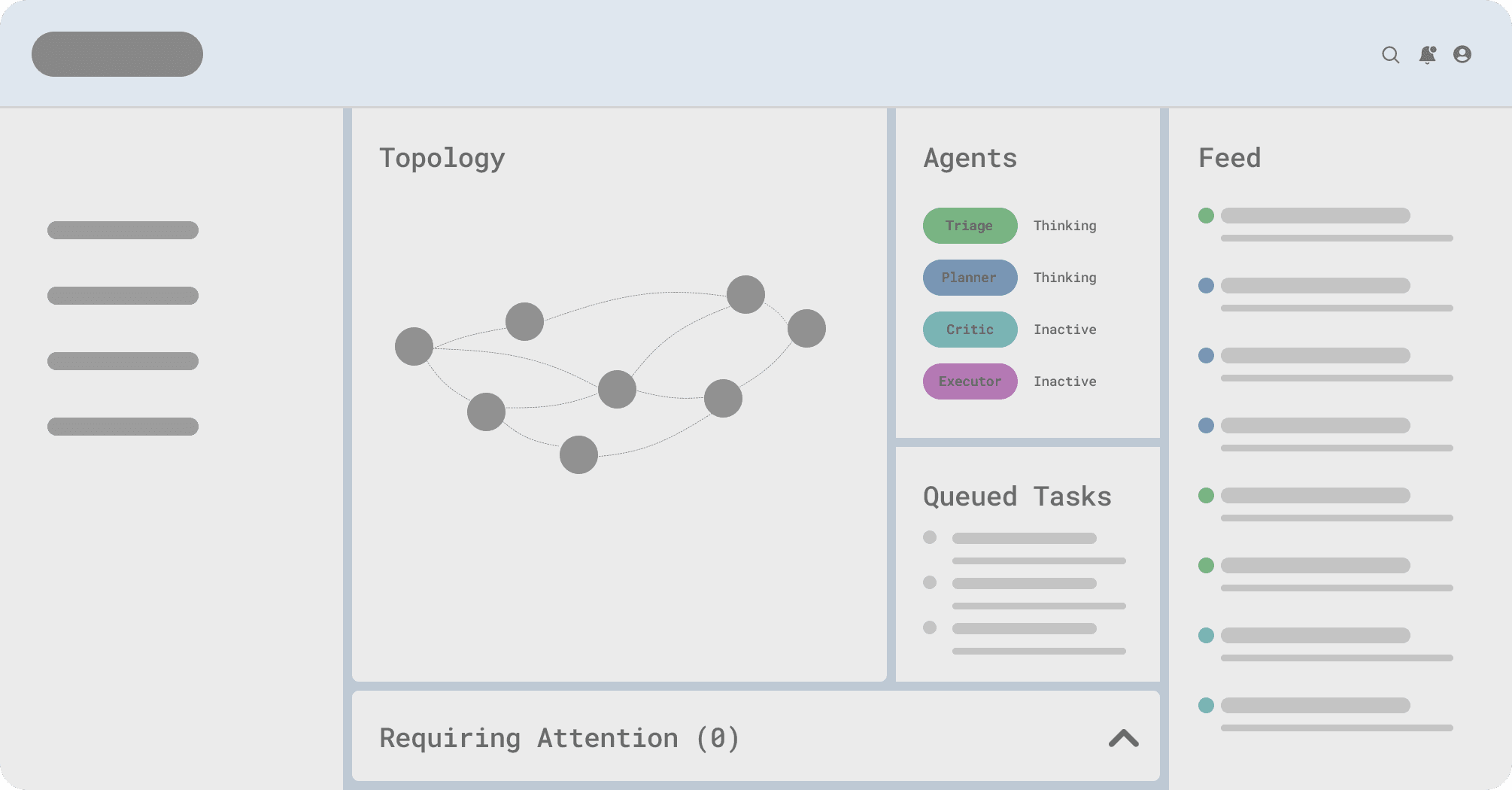
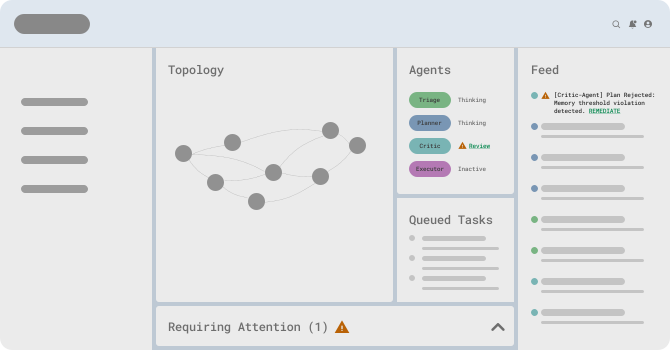
Before establishing the visual design, I defined the structure and layout of the app. I mapped the core components (topology, agents and feed) into a grid to ensure the interface could scale as complexity increased.
Overview

The Control Tower

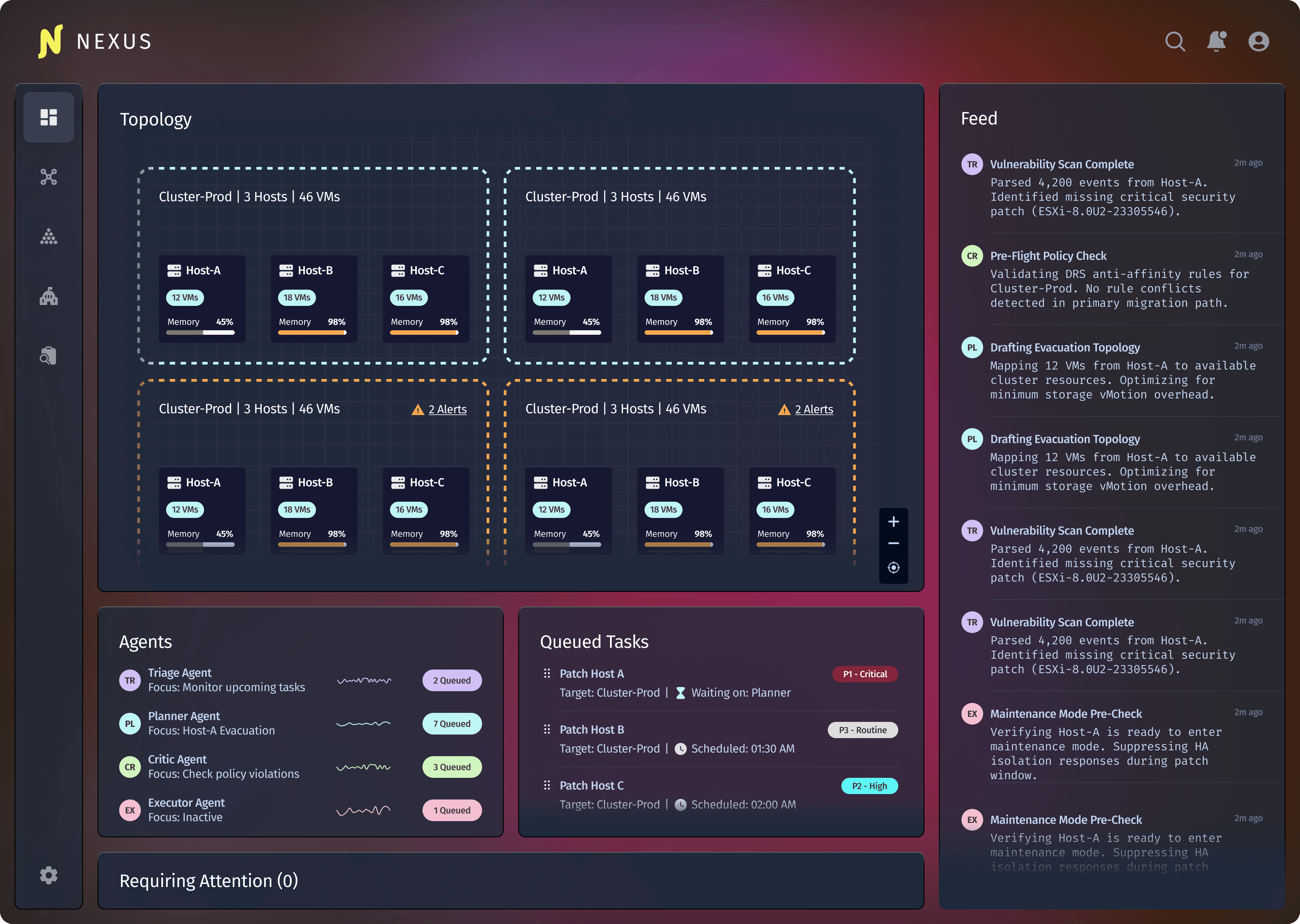
In autonomous systems, high-level situational awareness is far more critical than granular task management. The primary dashboard centers on a live topology map, allowing infrastructure operators to monitor health and active agent workflows at a glance without getting bogged down in execution logs.

Agent Roster

Abstracting the AI

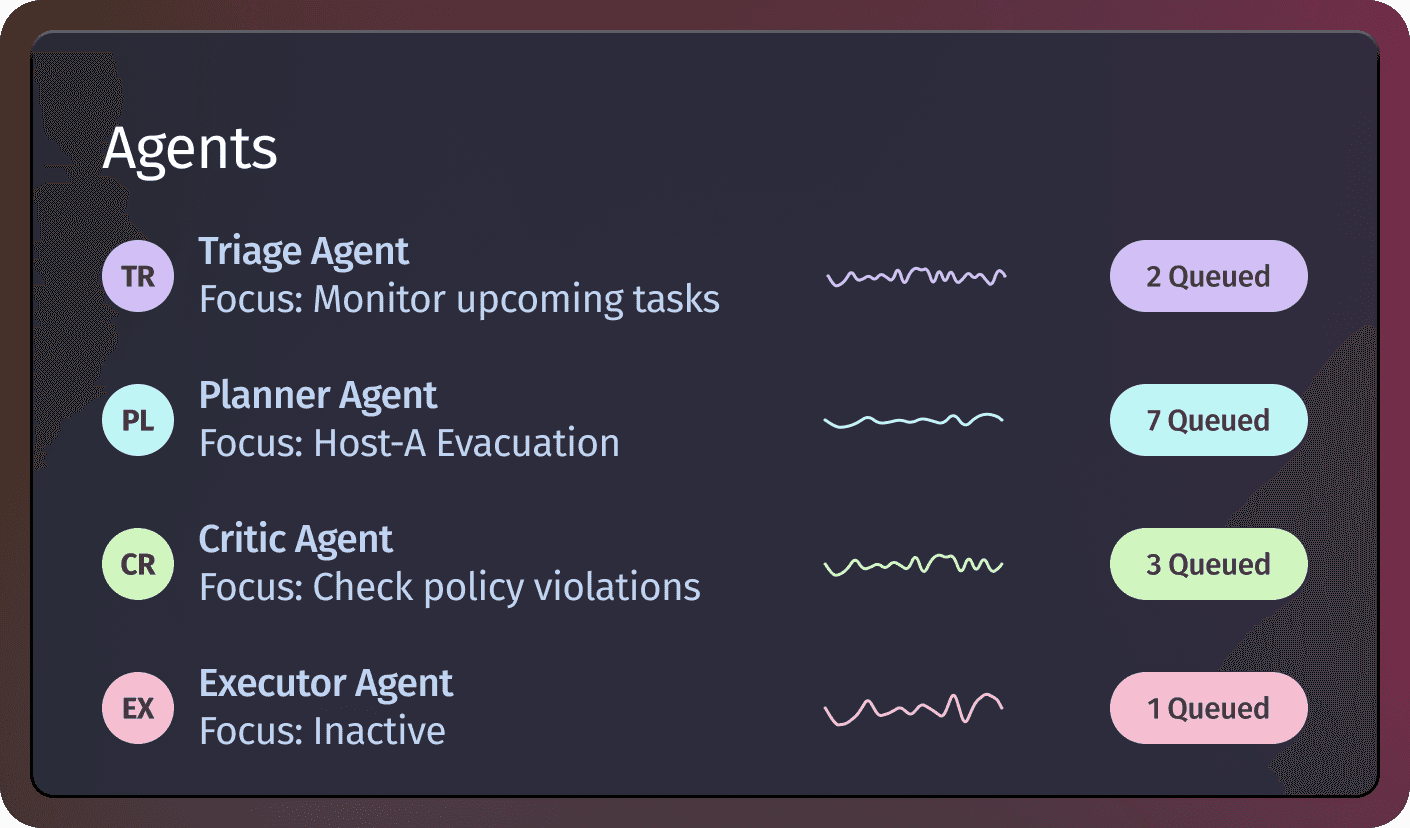
Trust requires transparency without cognitive overload. Instead of generic status indicators, the Agent Panel reveals each agent's specific intent, like "Host-A Evacuation." Paired with live activity waveforms and queued workloads, operators can instantly validate the AI's logic at a single glance.

Feed

Explainability as a Feature

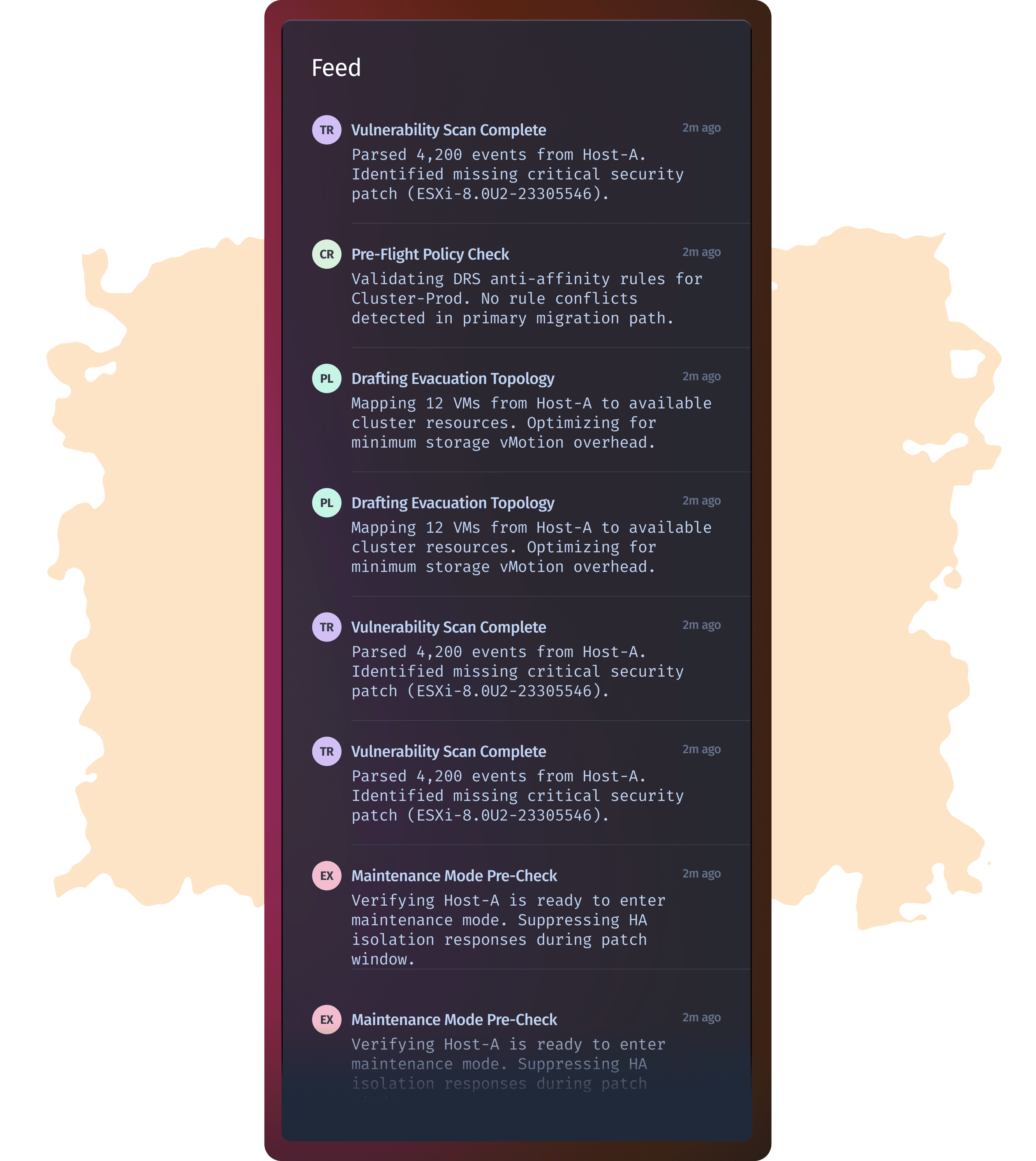
Enterprise AI cannot operate in a black box. The live feed serves as a highly visible audit trail, translating complex backend agent actions into human-readable logs. This ensures operators can track exactly how decisions are made, a non-negotiable requirement for system compliance.

Escalation: Critic Agent Intervention

Visualizing System Constraints

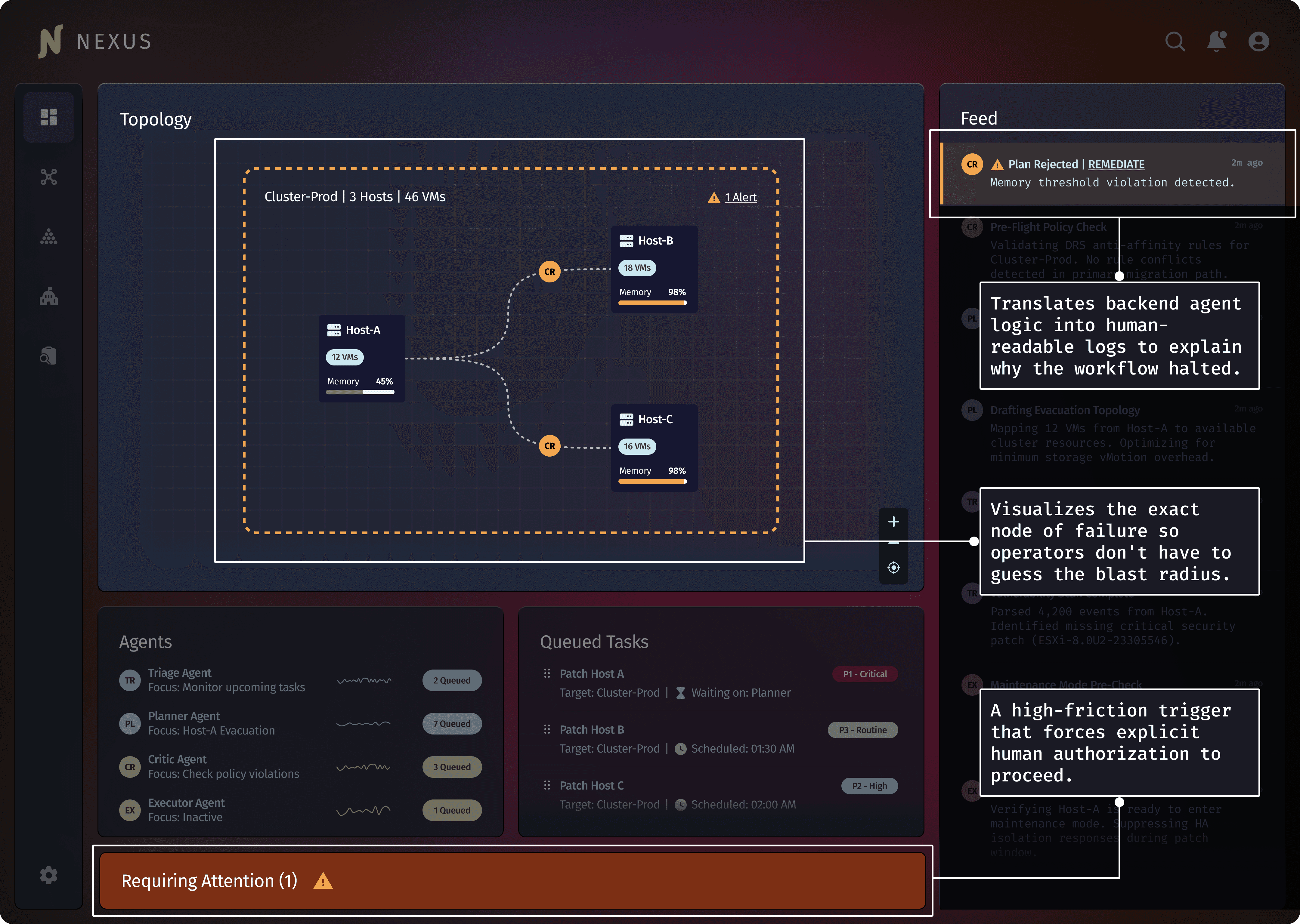
System trust requires showing not just what failed, but where. When a threshold violation halts the workflow, the Critic Agent is visualized directly on the topology map at the point of failure. This immediate spatial context empowers operators to make rapid, informed diagnostic decisions before the final handoff.

Overview

The Control Tower

In autonomous systems, high-level situational awareness is far more critical than granular task management. The primary dashboard centers on a live topology map, allowing infrastructure operators to monitor health and active agent workflows at a glance without getting bogged down in execution logs.

The Control Tower

In autonomous systems, high-level situational awareness is far more critical than granular task management. The primary dashboard centers on a live topology map, allowing infrastructure operators to monitor health and active agent workflows at a glance without getting bogged down in execution logs.

Overview

Agent Roster

Abstracting the AI

Trust requires transparency without cognitive overload. Instead of generic status indicators, the Agent Panel reveals each agent's specific intent, like "Host-A Evacuation." Paired with live activity waveforms and queued workloads, operators can instantly validate the AI's logic at a single glance.

Feed

Explainability as a Feature

Enterprise AI cannot operate in a black box. The live feed serves as a highly visible audit trail, translating complex backend agent actions into human-readable logs. This ensures operators can track exactly how decisions are made, a non-negotiable requirement for system compliance.

Agent Roster

Abstracting the AI

Trust requires transparency without cognitive overload. Instead of generic status indicators, the Agent Panel reveals each agent's specific intent, like "Host-A Evacuation." Paired with live activity waveforms and queued workloads, operators can instantly validate the AI's logic at a single glance.

Feed

Explainability as a Feature

Enterprise AI cannot operate in a black box. The live feed serves as a highly visible audit trail, translating complex backend agent actions into human-readable logs. This ensures operators can track exactly how decisions are made, a non-negotiable requirement for system compliance.

Escalation: Critic Agent Intervention

Visualizing System Constraints

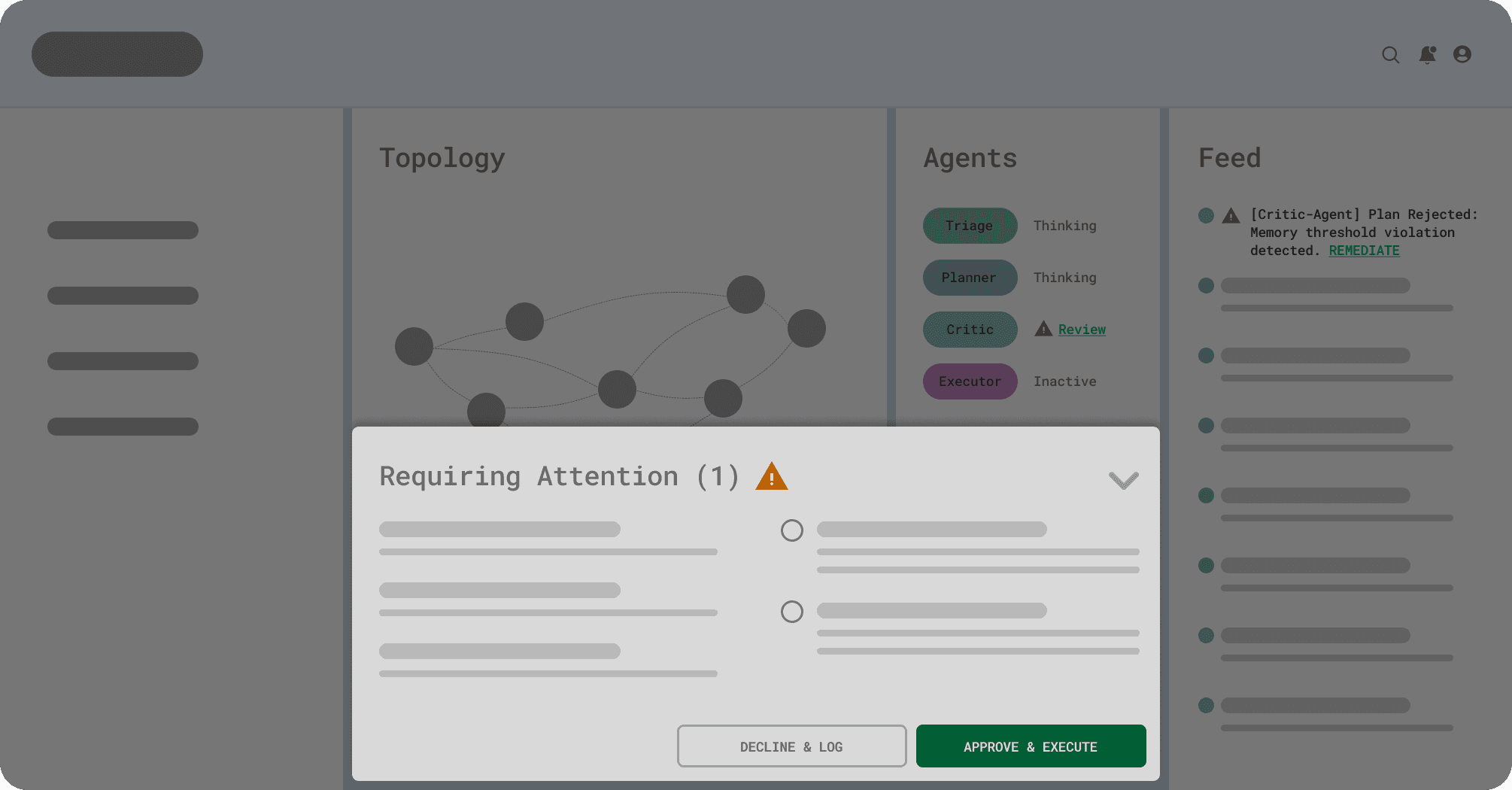
System trust requires showing not just what failed, but where. When a threshold violation halts the workflow, the Critic Agent is visualized directly on the topology map at the point of failure. This immediate spatial context empowers operators to make rapid, informed diagnostic decisions before the final handoff.

Escalation Modal

Human-in-the-Loop

For mission-critical infrastructure, friction is a feature, not a bug. When the Critic Agent detects a threshold violation, the workflow intentionally halts and surfaces an Escalation Modal. This forces explicit, context-rich human authorization before the system executes any high-risk server migrations.

Escalation Modal

Human-in-the-Loop

For mission-critical infrastructure, friction is a feature, not a bug. When the Critic Agent detects a threshold violation, the workflow intentionally halts and surfaces an Escalation Modal. This forces explicit, context-rich human authorization before the system executes any high-risk server migrations.

Escalation: Critic Agent Intervention

Visualizing System Constraints

System trust requires showing not just what failed, but where. When a threshold violation halts the workflow, the Critic Agent is visualized directly on the topology map at the point of failure. This immediate spatial context empowers operators to make rapid, informed diagnostic decisions before the final handoff.

Escalation Modal

Human-in-the-Loop

For mission-critical infrastructure, friction is a feature, not a bug. When the Critic Agent detects a threshold violation, the workflow intentionally halts and surfaces an Escalation Modal. This forces explicit, context-rich human authorization before the system executes any high-risk server migrations.

From Pixels to Production

From Pixels to Production

From Pixels to Production

Static mockups fail to capture the reality of agentic AI. To truly validate the interaction loops, streaming UI states, and perceived latency of the Control Tower, I needed to test it in the browser. Leveraging Claude Code and Lovable, I developed a functional React-based front-end prototype. Currently in active development, this live build bridges the gap between design and engineering, providing a zero-ambiguity blueprint for the final implementation.

Status: 70% Complete / Active Build

User name: staylor@acme.com
Password: TestIterateRepeat!

User name: staylor@acme.com
Password: TestIterateRepeat!

Takeaways

Takeaways

Takeaways

Designing enterprise AI is fundamentally different from traditional SaaS. It is an exercise in building trust, as it is assumed to be non-existent by default.

  • Friction is a Feature: In consumer apps, we design to remove friction. In mission-critical AI, we must intentionally inject it (via escalation modals and physical handoffs) to prevent autonomous disasters.

  • Transparency Beats Magic: Operators don't want a "magic button" that fixes servers. They need spatial awareness (Topology) and chronological auditing (Feed) to trust the system's logic before authorizing action.

  • Focus Over Status: Shifting agent indicators from generic states ("Thinking") to specific intents ("Evacuating Host-A") transforms a black-box AI into a collaborative team member.